
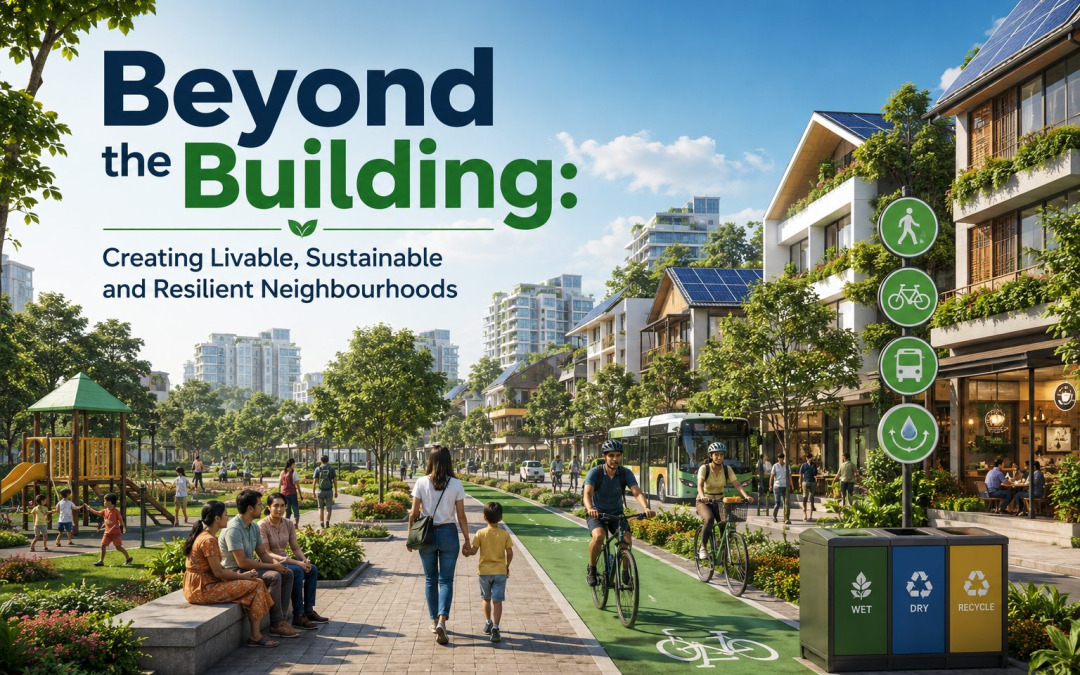
“A building is not sustainable simply because it is newly constructed. Its real sustainability begins with how we use, maintain and care for it over time.” When we think about a good home or a good neighbourhood, we often think about beautiful architecture, attractive interiors, landscaped gardens or modern amenities. But there is another aspect that is equally important and often overlooked—“how we maintain and care for the built environment around us.” Our buildings and neighbourhoods are living environments. They age, respond to weather, consume resources and are used every day by people of different ages and abilities. The quality of our built environment therefore depends not only on how it was designed, but also on how responsibly we manage it.
A building needs care, not just construction
- The life of a building does not end when construction is completed. In fact, that is when its longterm journey begins.
- Regular inspection and preventive maintenance of roofs, terraces, plumbing, electrical systems, drainage, waterproofing, lifts, fire-safety systems and common areas can prevent small defects from becoming major problems.
- A leaking pipe ignored today can become a damp wall tomorrow. Poor terrace maintenance can result in seepage. Blocked rainwater outlets can contribute to waterlogging during heavy rainfall.“Maintenance is therefore not an expense to be postponed; it is an investment in the life of the building.”
Water: Protect it, manage it, respect it
Water is one of our most valuable resources, yet a considerable amount is wasted through leaking fixtures, inefficient cleaning practices and poor maintenance.
Simple measures can make a difference:
- Repair leaking taps and pipes promptly.
- Keep rainwater outlets and drainage systems clean.
- Harvest rainwater wherever feasible.
- Reuse appropriate greywater for gardening and other non-potable purposes.
- Avoid excessive use of water for cleaning common areas.
- Ensure that rainwater has an opportunity to infiltrate into the ground rather than being completely paved over.
“Good water management is not only about installing systems. It is also about “changing everyday behaviour.”
A green neighbourhood is more than a landscaped neighbourhood
- Trees and vegetation are sometimes treated as decorative elements. They are much more than that.
- Trees provide shade, reduce heat, improve air quality, support biodiversity and help manage stormwater. In an increasingly hot urban environment, a mature tree can be one of the most valuable assets of a neighbourhood.
- Instead of constantly replacing existing trees with ornamental landscaping, we need to
- “protect mature trees, choose appropriate local species and create spaces where soil and rainwater can interact naturally.”
A sustainable landscape should be beautiful—but it should also perform.
Waste begins at home
- A clean neighbourhood cannot be created only through municipal collection systems. It begins with what each household does.
- The principle is simple:
- **Reduce → Reuse → Repair → Recycle → Recover**
- Segregating waste at source, composting organic waste where feasible, avoiding unnecessary single-use plastics and choosing durable products can significantly reduce the pressure on our waste-management systems.
- And perhaps we need to bring back an important habit:
“Repair before replacing.”
Extending the life of furniture, fixtures, appliances and building components is itself a form of sustainability.
The spaces between buildings matter
- A neighbourhood is not defined only by its buildings.
- The spaces between them—footpaths, streets, gardens, play areas, seating spaces, parking areas and community spaces—determine how people experience their neighbourhood.
- A truly livable neighbourhood should allow people to walk safely, children to play, older people to sit and interact, and persons with disabilities to move independently.
Good neighbourhood design should therefore ask:
“Can people walk here? Can they meet each other? Can children play safely? Can an elderly person use the space comfortably? Can a person with a disability access it?”
These are not luxury questions. They are indicators of a “livable neighbourhood.”
Resilience begins before the disaster
- Our buildings and neighbourhoods also need to be prepared for extreme events.
- Floods, heavy rainfall, heatwaves, fires and other emergencies remind us that resilience cannot be created at the moment of disaster. It has to be built into everyday management.
- Residents should know where emergency exits are located, where fire-fighting equipment is kept, what the emergency assembly point is and how to respond during an emergency.
- Common passages, staircases, fire exits and access roads must never become storage spaces.
“Preparedness is not only the responsibility of authorities. It is a shared responsibility of every resident.”
Use less energy, live better
- Sustainability does not always require expensive technology.
- Using daylight effectively, ensuring adequate ventilation, reducing unnecessary lighting and cooling, maintaining air-conditioning systems and using energy-efficient appliances can all reduce energy consumption.
Sometimes the most sustainable solution is also the simplest one:
“Use what you need. Maintain what you have. Avoid what you don’t need.”
Shared spaces need shared responsibility
- Perhaps the most important principle of all is that a neighbourhood is a collective environment.
- The lift, staircase, garden, parking area, play space, entrance lobby, waste area and fire-safety equipment belong to everyone.
- If we damage something that belongs to everyone, we are ultimately damaging our own environment.
A simple principle can guide us:
“What belongs to everyone must be cared for by everyone.”
From property to place
- We often refer to our homes as *property*. But a home is much more than a property.
- It is a place where people live, grow, interact, celebrate, age and create memories.
- Similarly, a neighbourhood is not merely a collection of buildings. It is a “community and an ecosystem”.
Creating sustainable built environments therefore requires more than architects, engineers, developers or government agencies. It requires residents to become active participants in maintaining the places they inhabit.
Five simple actions
Perhaps we can begin with five everyday habits:
OBSERVE – Notice problems before they become serious.
MAINTAIN– Take care of buildings and infrastructure regularly.
REPAIR – Fix things instead of immediately replacing them.
REDUCE – Reduce water, energy and material consumption.
RESPECT – Respect shared spaces, people and nature.
Building a better neighbourhood, one building at a time
As architects and designers, we often focus on creating buildings that look good and function well. But the true success of a building is measured over many years—by how comfortably people live in it, how efficiently it uses resources, how well it responds to changing environmental conditions and how responsibly it is maintained.
Sustainability is therefore not a feature that we simply add to a building.
“It is a way of living with the building.”
And resilience is not something we create only after a disaster.
“It is something we build through everyday preparedness, maintenance and responsible choices.”
At Aquila Projects, we believe that caring for the built environment is an extension of good design. Because ultimately, “good design is not only about creating beautiful spaces—it is about creating places that remain healthy, functional, adaptable and livable for years to come.”
“A better building creates a better neighbourhood.
And better neighbourhoods create a better quality of life.”